Showing posts with label basic photography terms. Show all posts

Wednesday, October 5, 2016

// // Leave a Comment

5 Beginner Photography Tips On Taking Great Photos

5 Beginner Photography Tips On Taking Great Photos

Photographs can last a life time. This is the reason why cameras never go out of style; rather they just improve in settings and functions to aid people in capturing moments, emotions, and even history. But despite the growing number of photography enthusiasts, not a lot is eligible to take and produce a photo that can elicit a “Wow! That is magnificent” or “That is incredible” response. And though many beginner photography tutorials are already available teaching different photography techniques, photography types, camera modes and so on, many beginning photographers continue to fail in taking wonderful pictures.

Understand the Concept of Composition
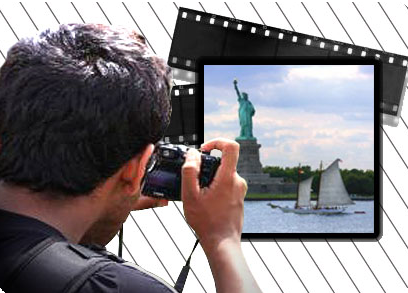

One of the most important things to keep in mind is that a good photograph is well composed. And composition is about everything that makes up the entire picture. Frame your scene before pressing the shutter of your camera. Check the placement of your subject. While centering the subject is fine in certain occasions, a good photograph would often have the subject off center, which adds more intensity to your photograph. Also, look for shapes, patterns, and lines as they can make good visual image.

Pay Attention to Exposure 

Another beginner photography tip to create a good photograph is to learn how exposure affects your images. Ever noticed why some pictures appear too dark or too washed out? Exposure is the measuring and balancing of light. And a poorly exposed image equates to being forgettable. Take control of your camera by learning and adjusting the shutter, aperture, or film speed. 

Capture Viewers’ Emotion

Learning beginner photography is fun because it allows you to capture different emotions of a given subject. However, a good photograph must also stir up the viewer’s emotion. So, whether you are up to take a picture of an elderly couple at a park or a starving child in a remote community, think what feelings you aim to evoke. How do you want your viewers to feel when they see your photographs? How intense is the emotion you want to stir up? Determine the feeling you want to affect rather than just shooting what you think is beautiful for you.

Convey A Story Through the Images 

Whether you are using a point and shoot camera or a DSRL, a good photograph always tell a story. Just consider the photograph of high-profiled individuals on the front cover or inside pages of TIME magazine, Reader’s Digest, or Forbes. An image of the person tells “who” the person is and “what” influence or power s/he has for his/her people. Additionally, a photograph of a place inundated by a hurricane tells a story of the calamity that left people at the edge of their lives. Photojournalism gives plenty of this kind and the story that each of the photograph tells sways the viewer’s feelings. 

Say Something About Life

There are too many things that happen in life, and whether you are only taking beginner photography or already in advanced photography, life is going to become an integral part of your subject. And a good photograph must say something about life and not just the action it creates. Show more than just the subject. An image of a marathon Olympics will surely look good in digital prints; likewise, a good angle lets you tell about life challenges and winning it. Additionally, a good image of sunrise can tell a new beginning or something more defined meaning for other viewers.
Photography is an art. The ability to capture and create a good photograph entails learning and experimentation. However, when people enroll for beginner photography courses they commonly associate good photographs with an expensive camera. On the contrary, a good photograph is produced with the elements listed above even before the photographer buys a premium camera brand.
Read More

Tuesday, October 4, 2016

// // Leave a Comment

Top Photography Terms For Beginning Photographers

Top Photography Terms For Beginning Photographers

Learning photography is never complete without understanding the most basic photography terms such as: ISO, aperture, shutter speed, depth of field, and so on. In fact, these photography terms are perhaps the first things that you are expected to learn before you explore the different techniques and genres of photography. Unfortunately, many beginning photographers and hobbyists of today are more interested in buying the latest DSLR and camera lens than understanding the definition of photography terms that affects a photograph.
Below are some of the terminologies that every beginning photographer needs to know. The way they are applied can either make or break the story or emotion a photographer is trying to capture and convey to his/her viewers.

APERTURE

This is also commonly known as an F stop. It simply pertains to the amount of light being let in through the lens. The size of an F stop affects the portion of a scene that appears in focus in the image. In practice, the lower the number the larger the aperture. An aperture opening of f1.4 enables a high shutter speed and not much in focus. On the other hand, an aperture opening of f2.8 enables almost as high shutter speeds and yields more focus, which is normally great for portraits.

SHUTTER SPEED

Just like aperture, this is one of the photography terms you’d be dealing a lot with from the moment you start learning about photography up to the time you move forward to the advanced stage.  Shutter speed refers to the exposure time a camera’s shutter is open. Ever wonder why some of the photographs you’re taking is more exposed than the rest? The shutter speed works in conjunction with the aperture in terms of controlling the total amount of light reaching the sensor of your camera. The longer your shutter speed is open, the more light it lets into the camera and the more your images become exposed.

ISO

ISO or Internal Organization for Standardization is a numerical rating that describes the sensitivity of a film to light. Using higher ISO makes your camera more sensitive to the light and results to a grainier images. On the other hand, the lower your ISO the less grainier the images will be. An ISO 100 is normally great for day light use, whereas, ISO 400 is good for twilight use.

FOCUS

In DSLR, focus literally refers to what can be clearly and sharply seen in the depth of field. There are different types of focus mode such as: macro; infinity; normal; auto focusing; manual focusing; single focus; and continuous focus, to name a few.

FLASH

This is the burst of light that comes from the camera when a picture is taken. Fill flash and red eye flash are two different types of flash you’d be using in your camera.
Again, these are just some of the commonly-used photography terms you’d be encountering in the industry. Whether you’re doing photography to earn a living or to fulfill a hobby, it’s imperative to know how these terminologies apply so that you can produce better photographs.
Read More